IF THIS SITE IS DOWN EMAIL SUPPORT@BLACKOPSHOSTING.COM
Leaderboard

Popular Content
Showing content with the highest reputation on 07/01/2018 in all areas
-
The access to this forum got very flaky a while back so I have been away. But It now it all seems to be hunky dory 🙂3 points
-
Welcome Rudygrey. Very nice looking Cag. Welcome to the Grey Family. Rudy looks very calm and relaxed. Looking forward to watching the two of you grow together.3 points
-
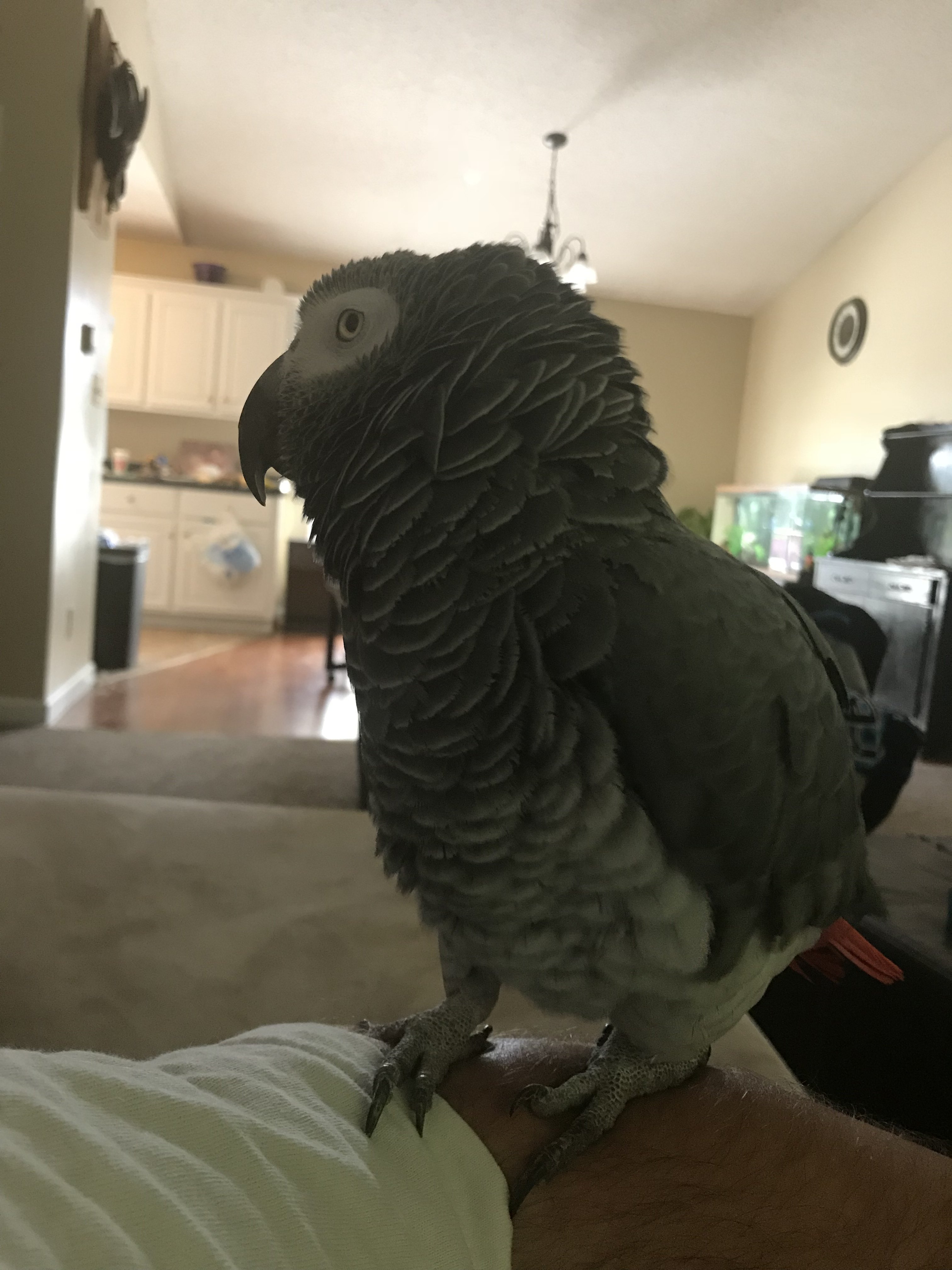
Yeah I feel like she’s happy I just got her late last night and she already sings to me 😄3 points
-
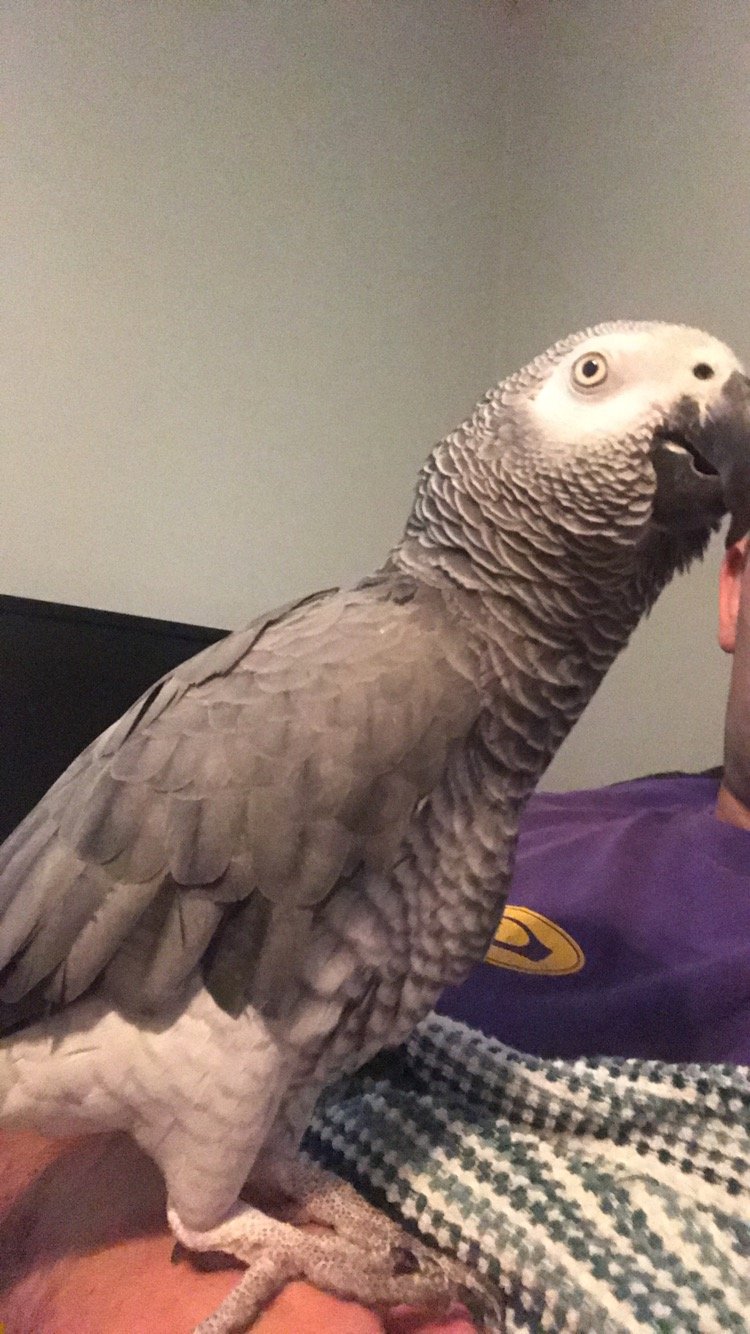
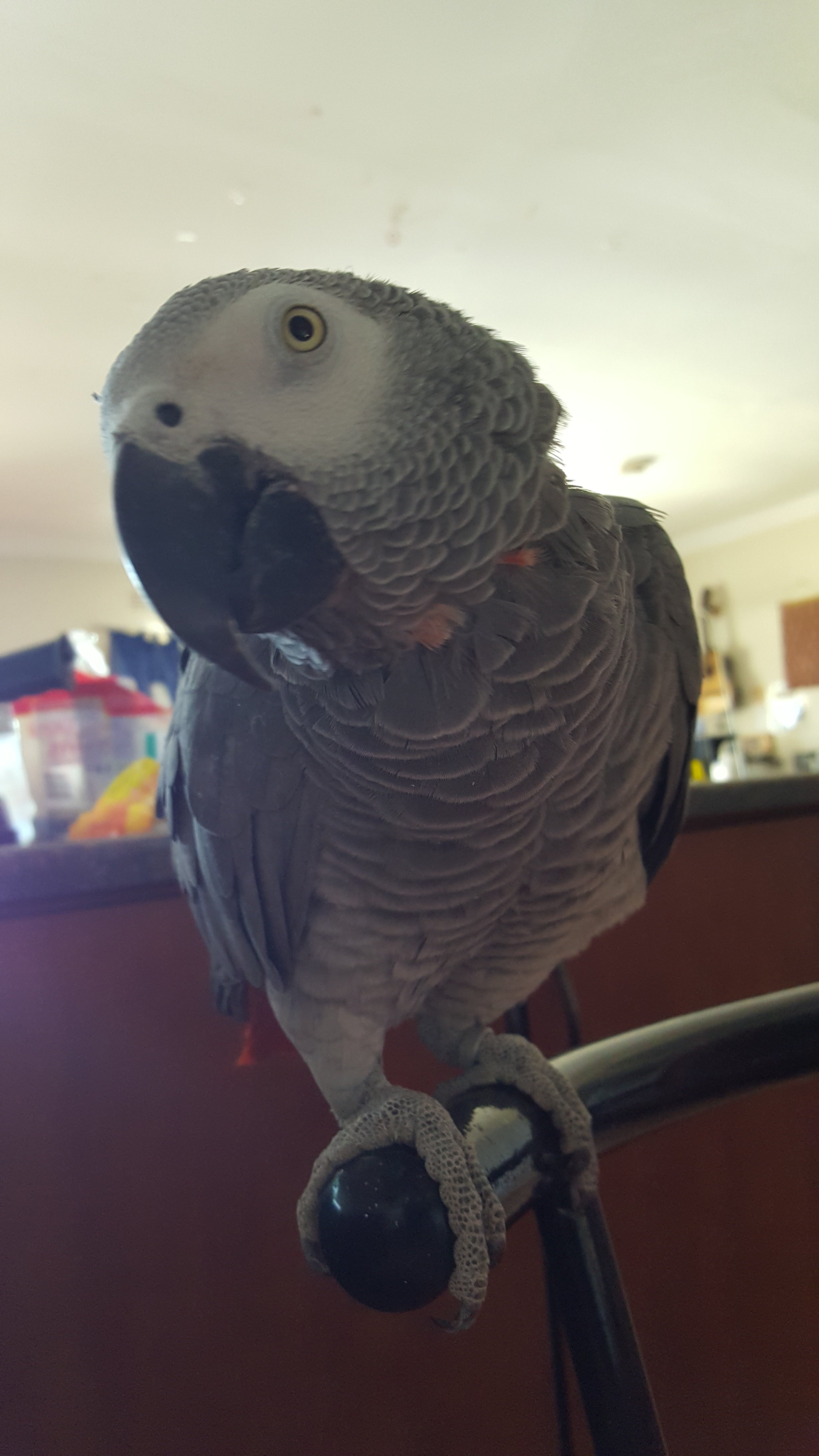
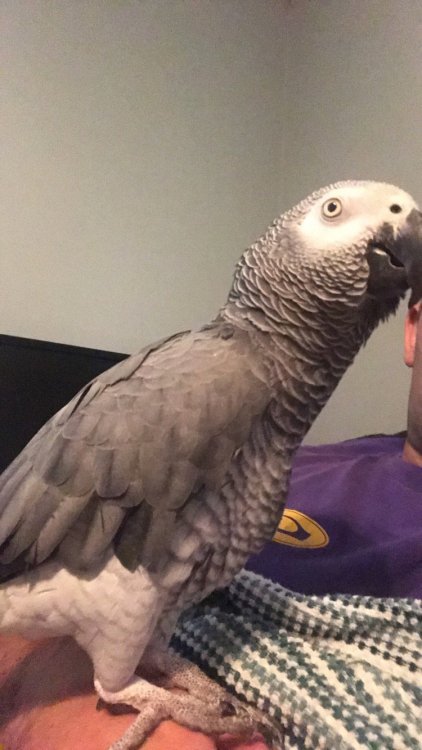
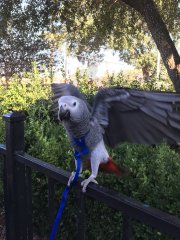
This is my new grey Ruby she is supposedly 5-7 years old I know it’s hard to tell but does anyone have a educated guess she is so sweet and seems to be trying so hard to talk to me any tips on keeping her happy?
 2 points
 -
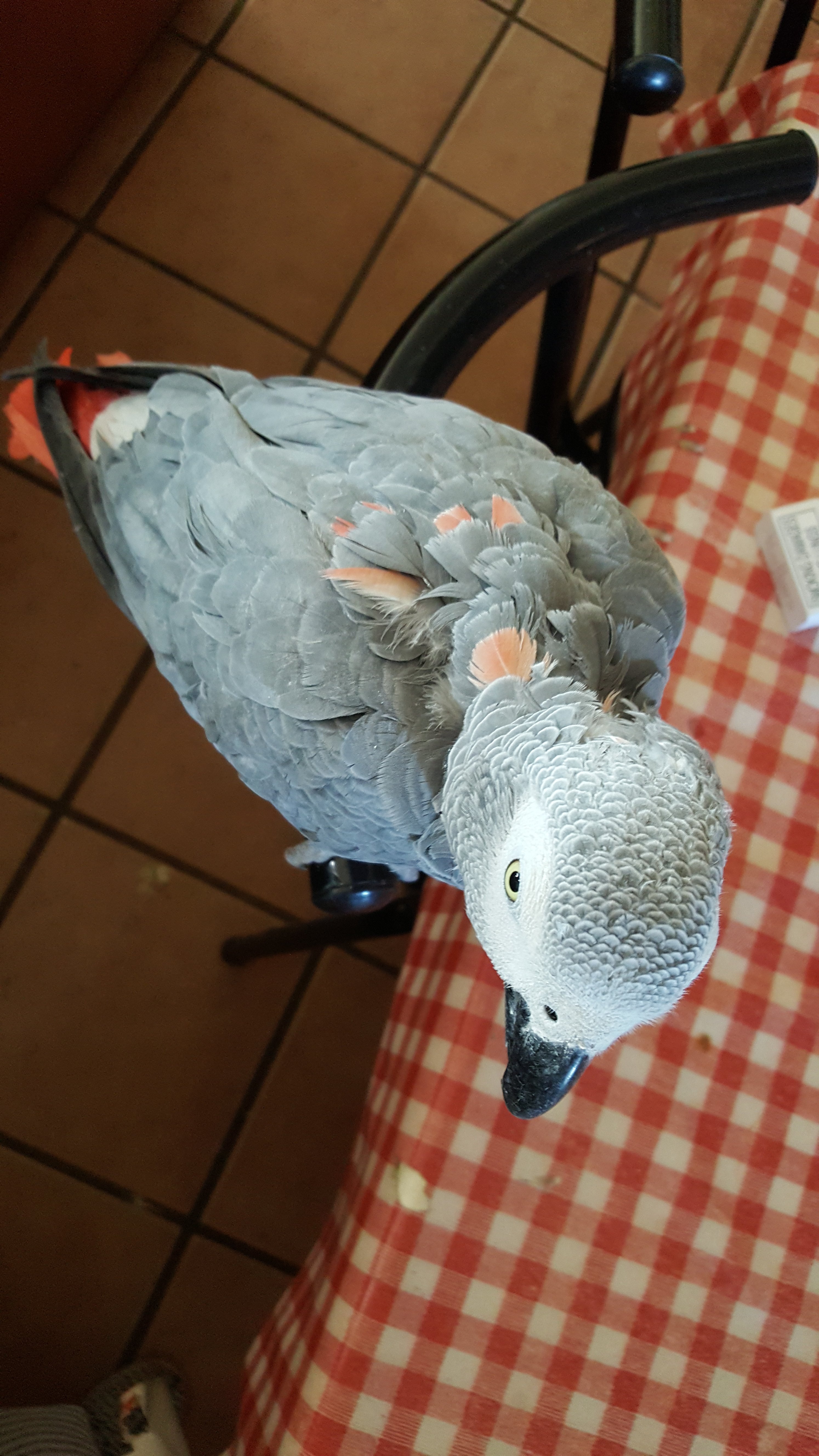
Welcome and thank you for the post and pictures. Your sweet bird is called a Red-factor Grey. This occurs naturally (genetically) and sometimes as they fall out, the replacement feathers will be grey. In extremely rare cases, it can be because of a medical condition. May I suggest, realizing that some of the foods mentioned are your Fid's favorites, it is advised that you should only feed 100% whole grain bread a couple times a week. Fruit, again very little should be fed to a Grey...it's mostly sugar with no nutritional value, 2-3 times a week which is great. White potatoes should be substituted with sweet potatoes. I am sure you know that they never can eat the "eyes" of a white potato. Eggs, 2-3 times a week is great. Suggestion, wash the egg before hard-boiling to reduce any chance of salmonella. Cut the egg in half, in the shell and serve the shell and all to your fid. You can even take the shell, after it is cooked and bake at 350 degrees and crumble over other fresh food. Hard pasta such as spaghetti (uncooked) is good substitute for bread. Have you ever made birdie bread? Get a cornmeal muffin mix similar to Jiffy, add baby food jars, (I use two), three eggs, with cooked and smashed shells, and go crazy with your choices of bird seeds, frozen mixed veggies, etc. Use your imagination...and bake to instructions. As a final thought, the food chain for a parrot is most to least, green leafy veggies, orange veggies, a safflower seed mix (staple), fruit, and bread. It's not the small amount of salt or sugar that can kill a parrot, it is the accumulation of such that will affect them in the long run. Finally, a couple times of week, boiled chicken bones (Legs) with a little meat on them, no or low-sodium tuna, and our favorite, a 1/2 tsp. of low/no-sodium peanut butter to start the day...(an excellent seed mix to leave in the cage 24/7 is Volkman's Large Hookbill Safflower Mix, no sunflower seeds. Two excellent on-line sources are Chewy.com and Amazon)2 points
-
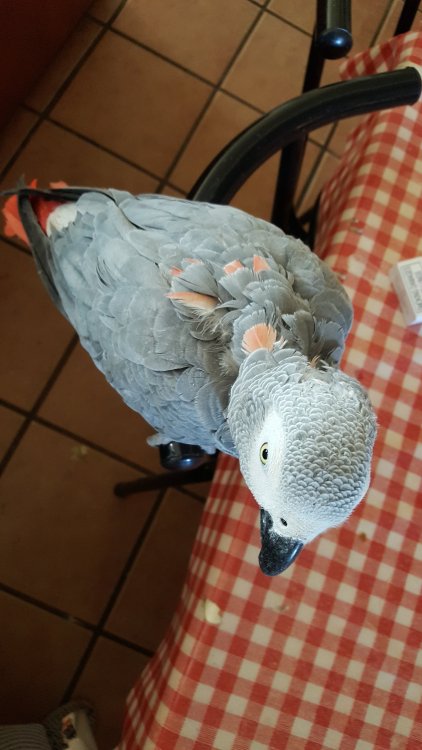
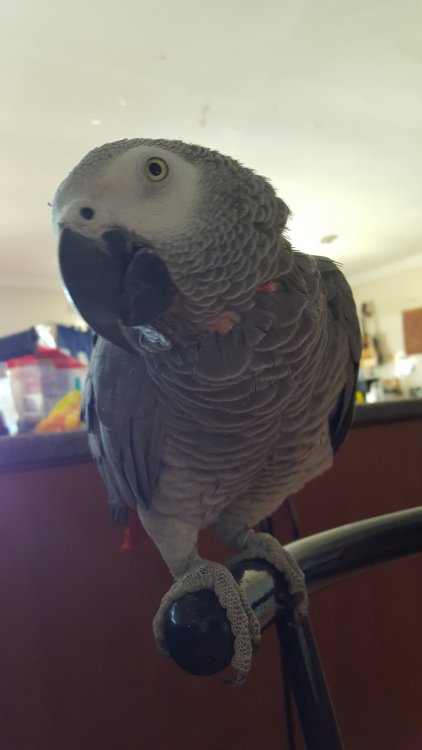
My beautiful Chjango (Big Boy) has pink feathers on his back and his chest. When he grooms himself sometimes they are pulled out and grow back with others sprouting. It started with one feather. Now he must have about 20. He is a healthy male and is 10 years old. Loving and very vocal, especially when it comes to food he will let rip with "Where's my tos (toast) apple, orange, egg egg egg, air (pear)." His favourite food is toast, mashed potato and egg, either boiled or scrambled. He is also an avid consumer of any fruit. I have attached a photo. D
 2 points
 -
Ruby is a beauty! Hello and welcome to the forum. As to keeping her happy, my grey is happiest when he has my full attention.2 points
-
Once they lose the dark baby eyes and they become the mature ones like she has its hard to determine age but its a good guess, she is lovely. You can keep her happy by taking care of her every whim, give her a good diet, a big cage with lots of toys and loads of time out of cage to spend with you and your family. You can find lots of threads here in various rooms on what to feed and not feed, ideas for toys that may be from common things in your house because you don't have to spend a fortune to entertain a grey, sometimes a simple box will keep them busy for a while. Looking forward to hearing and seeing a lot more from Ruby.2 points
-
I'm afraid we are not trained vets so will not be able to offer much advice about what's going on here. If it were my bird in that situation then I would visit an avian vet for a checkup. Changes in behaviour like that could potentially indicate a problem.2 points
-
Very tearful. May God be with you always. May all the beautiful feathered angels you have nurtured here be there to help guide you home when it is your time.2 points
-
Hello, I have my African grey boy for 4,5 months now, he's almost 2 years old and had only one owner previously. He has amazing personality and such a fast learner, he learned already so many new words and sounds from me. He's very comfortable with me and constantly staying on his one leg, and has the belly shiver when I even talk to him ( the sign that he's actually happy). He doesn't have any problem to take food from my hands and even from my lips and he gives me lots of kisses, he's not scared to be very close to my face and even touches my hair with his beak, but at the same time in no way he will step up on my hand ( but he was stepping up on the previous owner). As soon as I'll put my hand next to him in the position to step up he becomes very scared and sometimes even starts to shiver or he's trying to "fly away". He can't fly at all as when I got him the previous owner clipped his wing terribly ( the vet did ), only 1 wing was clipped which is totally wrong and was literally until the "meat" ( so he had no feathers there at all, and he was falling so many times that I constantly had blankets on the floor so in case he falls he won't hurt himself. Still at the beginning he even had a bit of blood there which was extremely upsetting. Hopefully the wings grew a bit back after quite a long time even if he still can't fly. I've never done anything bad to him to be so scared of my hands for the stepping up, so I really don't understand his reaction. I can see he loves me and he's constantly looking for contact with me but at the same time he doesn't let me touch him completely. He doesn't live in his cage. I mean, I put the training stand right next to his cage with an open door so he can get out any time and goes from the cage's door to the stand and he's always free, he also sleeps on the stand or inside his cage whenever he wants ( I don't cover him at night, I just turn the light when he's ready to sleep). I'm extremely patient with him as I do love him a lot but I'm getting a bit desperate with what to do and how to make him step up and what am I doing wrong? Any of your advice will be much appreciate it and I really hope someone can help me with it. Thanks a lot in advance!!1 point
-
Well Ajax went to the vet yesturday. He was NOT happy, he growled at her the whole time, but he did well. She mentioned 2 things that concerned her. 1. He was a little overwieght, but she said that was expected since he hasn't been out of his cage to get any exercise, 2. He has a few pink feathers on his belly. The owners said that he has had these feathers since he was a baby. I know I should have asked her but has anyone ever dealt with this? What kind of a problem could this be? Kerri1 point
-
That’s good our ruby is great she loves dancing and whistles a lot and talks a little, I think we’ve given her a much much better home than she had and she is a happy girl now1 point
-
Their personality will take months to come out. We thought we knew our Huey but he keeps surprising us with things his old owner told us he did and is just now starting to do for us over 6 months later.1 point
-
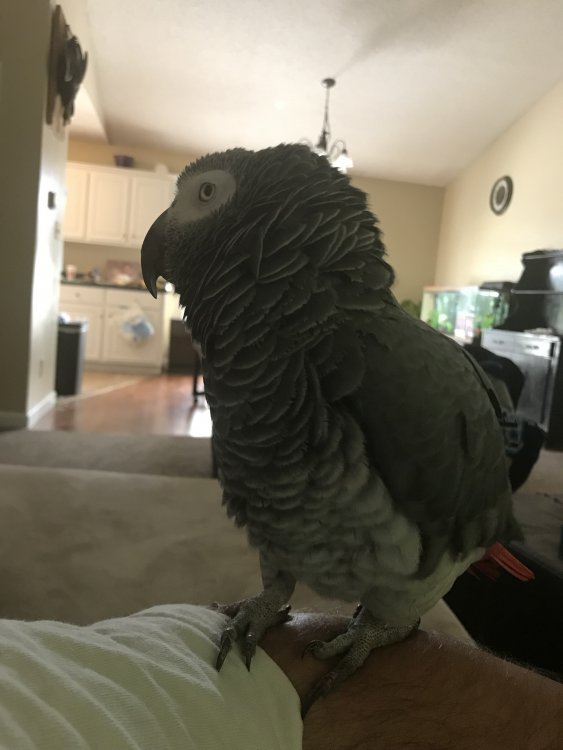
Thank you she is so sweet and loves to be held maybe she’ll come around more with time today is only her second day with us lol I just want her to be as happy as can be!
 1 point
 -
Its possible he has developed a hand phobia, some birds just do not like hands so offer an arm for him to step up on and see if the reaction is the same. I don't usually wear nail polish so if on occasion I do wear some my grey doesn't like it at all, she thinks its something out to kill her. Its good you are very patient with him and it can take longer than 4.5 months for him to fully trust you as grey time is slow time. As for the wing trim, how can someone think that clipping only one side is a proper trim, the way you describe your bird was butchered plain and simple and that person should never touch your bird or any bird again, I'd be mad as hell if it happened to my bird, that person would be "butchered" if you get my drift.1 point
-
Most greys do not like being touched unless its by their chosen ones, for instance my grey will not allow me to rub her neck but will allow my husband to do almost anything with her for she has chosen him as her favorite person so you may have to settle for not getting to touch her much. She is biting because she is telling you she doesn't like what you are doing, you can't force her to do anything she doesn't want to do but you can learn to read her body language to avoid most bites. Not biting hard is giving you warnings but if you persist she may deliver one you will remember. The wings will grow back and she may already know how to fly if allowed to fledge when she was younger but time will tell, allow them to grow back and leave them that way for they are birds and meant to fly.1 point
-
Also she had her wings clipped when I got he but if I let them grow can she learn to fly in a controlled environment? Or will they not fully grow back1 point
-
Ruby seems to not like being petted she doesn’t mind you holding her but doesn’t want to be petted she also bites a lot not hard but I was wondering how can I discourage the biting and screeching?1 point
-
From the album: Chu-Chi
1 point -
Yesterday my African Grey, Frankie a female of 19 years, stopped eating at sleeptime. Today she only drank some water. She just regurgitated it. She did the same about two weeks (13th of June) shortly before laying an egg. I took her to the vet then, he told me she has diarhea after he examined her poop. Since then her poop is brown not green despite finishing the medication the doctor gave her. Now she is back to sleeping. It is is not her first egg ( going on for 10 years at least she lays on and off every 6 months ). I have been feeding her calcium foods and adding supplements to her food and water since the last egg. I am afraid I am encouraging egg laying somehow. Where I live, Kuwait, there is only one avian vet the one she had seen lately. He did not even suspect the egg presence. Now I am waiting for her to lay her egg. I have another bird I think it is a male, I kept them apart since her last egg (13th of June). I am not sure how to act in front of this regurgitation, I have only seen her do that these two times. She regurgitated just water this time, last time there was food. I just presented her with water she took it 3 times. I put a water boiler next to her cage and I covered the side of the cage since I read steam helps her relaw her botox muscles to release the egg. She just popped water since she is not eating. And she regurgitated her water again.1 point
-
Usually when they regurgitate food as a sign of affection they don't usually bring up only water and if she is not eating then its time to see an avian vet. The one you mention does not sound like they are very reliable so see if you can find a reputable one even if you have to travel some to get there. Her not eating is not a good sign so please get her some help asap and let us know what you find out.1 point
-
Well, I'd love to see a video of that sleep talking business1 point
-
Are you going to finish raising the baby or is the breeder going to finish it out? That pic is an awful young one! Cute.1 point
-
Luvparrots I live in Englewood Fl. I don’t have a name yet I am thinking Maya 😬1 point
-
Welcome to the forums! I love baby grey photos! Look at that cute little ball of fluff! Do feel free to ask any questions- we have lots of members who will be happy to help and advise!1 point
-
Welcome Alex. Rico is a cutie.1 point
-
Hi guys. Thanks for the welcome messages and your advises. I had the same interpretation of his behaviour after some online search but I could not be sure since I am completely new with Greys. I didn't expect he would be so friendly straight away, but yes it seems so. So, I will try to discourage him when he starts with this "love" dance :-) However, he still wont stand on my hand - this will may take some time I know. I took the same cage he used to be cause I thought the less changes in the new environment the less stress for him in the beginning. But I will consider a new bigger cage as well, although he seems to enjoy staying on top of it most of the time. Yesterday I noticed something funny: he stays on top with closed eyes standing on one leg (as you see in the picture) pretending he is sleeping, but then he starts mumbling and whistling continuously; it is really hilarious. Anyway, thanks again. You were really helpful. I will drop some updates from time to time.1 point
-
Welcome to the Grey Family, Lil! What is your Cag's name? Can't wait to learn more about the both of you. Like, where do you live?1 point
-
This is my first gray and I don’t have any other birds. I did have an Electus but my daughter has it now when I moved to Florida.1 point
-
Hello Alex and welcome to our family. It appears he is in love with you, he is showing his desire to mate with you and that should be discouraged as it will only frustrate him, when he gets like that ignore him for a few minutes and do not touch him beyond the head.1 point
-
Hello Lil and welcome to our family. Try to read thru as many of the threads here for lots of helpful advise. If you have specific questions do not hesitate to ask. Do you have any other birds? Is this your first grey?1 point
-
I just realized we rescued her 5 weeks ago yesterday.1 point
-
Congratulations on your new baby! And may I be one of the first to welcome you to Grey Forums! The behavior you have described is actually a loving gesture of his wanting to share his food with you. Sounds like he's warming up quickly to you, which is great! I'm not sure what your plans are with his cage, but my recommendation is that when you're able, to get him something bigger. Greys love space to play, flap their wings, swing, etc. etc. This particular cage is actually intended for much smaller birds. Again, welcome to the forum, and keep on posting!1 point
-
It makes me so sad to see this. Just know you are loved and appreciated, and your contributions are a legacy here. God bless you and Maggie.1 point
-
Well that is just damn sucky, i will leave you some good karma to make up for it i got two karma's woop i hope i dont get bad karma, those damn bad karma rascals:P1 point
-
And they strike again (the negative karma police, that is)! I'd say someone doesn't like me very much. At least I've given them a new hobby :silly:. Back to PBFD, does anybody remember the user name of the person who said their grey was diagnosed with it? I think they also had a second grey that had polyoma, and a cockatoo. I'm curious about how her birds are doing now. I hope that the cockatoo didn't come down with anything .<br><br>Post edited by: spookyhurst, at: 2007/12/13 05:461 point
-
Mine has pink feathers everywhere also, I wouldn't worry about that!1 point
-
LOL...I bet whoever took your Karma is burnin' right now seeing your karma go up...LOL1 point
-
spookyhurst im angry that someone took karma from you, your post was informative & posted in good faith,it annoys me that members remove karma, i think they should at least have the courage to send a PM & explain why they did it.Karma right back at you1 point
-
I'm sorry that someone felt compelled to take away your karma, Spookyhurst, I would rather they send you a pm explaining why they thought you deserved it. Your post was the first time I have heard about the pink feathers being a sign of illness but that does not mean that it is not true, thanks for posting it for us to read about. Yes it was depressing to read but if there is any truth to it then forewarned is forearmed.1 point
-
Wow, someone didn't like my response about PBFD, because my karma went down. Let this be a lesson to you all: don't share depressing information :pinch:. Anyhoo, Kerri have you posted a picture of Ajax anywhere? He sounds like a cutie! I'd like to see his red freckles (I think red factors are adorable :kiss:)1 point
-
I too wouldn't worry either since he seems happy and talks, I am going for the red factor as the case. Kerri why don't you post a picture showing us the pink feathers and we all can have a look at what you are talking about. It could be that since it is just a few scattered feathers they look pinkish instead of red.1 point
-
Thanks for all of the information, I think he is fine since he seems quite happy and talks alot.1 point
-
Well Kerri, I wouldn't be too worried about it unless you don't see the dusty beak and your grey acts depressed. My money is still on Red factor.1 point
-
Hi Kerri, as judygram & BMustee have said the red feathers indicates the red factor in a grey.My newest addition has red feathers on his legs, Here is a link about colour mutations http://www.greyforums.net/forums/african-grey/35360-color-mutations.html#383841 point
-
Yes she is an avian vet, and she seemed very informed for other areas, training, food etc... She even gave me advice on Keno my B & G. Maybe I am dwelling on that comment too much because she mentioned it once but never discussed it with me. It's so cute though he has alot of pink feathers! Thanks for your replies! Kerri1 point
-
Pink feathers would indicate the red factor in greys, and that is special. There is nothing wrong with them, it just means that he has the pigmentation in some of his feathers that makes them red or pink as you call it. Some people would love for their greys to have that coloring and we have a few here on the forum that have greys with that red factor in them. You have a special grey, Kerri. He definitely needs some exercise to burn off that fat he has put on and you need to work on that but enjoy the red or pink feathers.1 point
-
go to the Color Mutations post and there are pics and info on Red Factors.1 point
-
It's Red Factor...nothing to worry about. Is your vet an Avian vet? My grey has a feather on the back of his neck with a pink dot on it, I think it's so cute.1 point